ChatGPT ads in short
ChatGPT Ads are paid placements that appear below an answer in ChatGPT. They are labelled as sponsored, shown separately from the response and selected largely on the basis of what someone is discussing at that moment. OpenAI started testing ads in the United States in February 2026. In August, it expanded to 31 European markets, including the Netherlands. Since 31 August 2026, businesses in those markets can buy ads themselves through Ads Manager.
For businesses, this is a new way to appear while people describe a problem, compare options and prepare a decision. Someone may not type “kitchen renovation The Hague”. Instead, they might explain that they want to renovate a small kitchen, have a fixed budget and need the work finished before summer. The ad system can take that context into account. Whether it deserves part of your budget depends on your category, your landing page and your ability to measure results.
This guide reflects OpenAI’s public documentation as of 25 September 2026. The platform is changing quickly, so check the linked sources before you make budget decisions.
From a US test to the Netherlands: a timeline
ChatGPT Ads moved from a small, managed test to a self-service advertising platform in about seven months. The dates below come from OpenAI’s announcements and help pages. They are useful context when you read older articles: advice written in the spring, when access mostly ran through OpenAI’s sales team and large commitments, no longer describes the situation for a Dutch business today.
| Date | What changed |
|---|---|
| 16 January 2026 | OpenAI announces plans to test ads for logged-in adults on the Free and Go plans in the United States and publishes its advertising principles. |
| 9 February 2026 | Ad testing starts in the United States. |
| May 2026 | Ads Manager opens, making the platform accessible to small and medium-sized businesses. |
| 18 August 2026 | OpenAI announces an expansion to 31 European markets, including the Netherlands, starting the following week through its sales team and partners. |
| 31 August 2026 | Self-service Ads Manager becomes available across the 31 European markets. OpenAI reports a US$1 billion annualised revenue run rate for ads. |
| 16 September 2026 | OpenAI introduces a Sponsored Agents test for select US advertisers, AI creative tools and integrations with HubSpot and Shopify. |
| 23 September 2026 | Expansion to Southeast Asia and Taiwan; ChatGPT Ads are now available in more than 60 countries. |
What does an ad in ChatGPT look like?
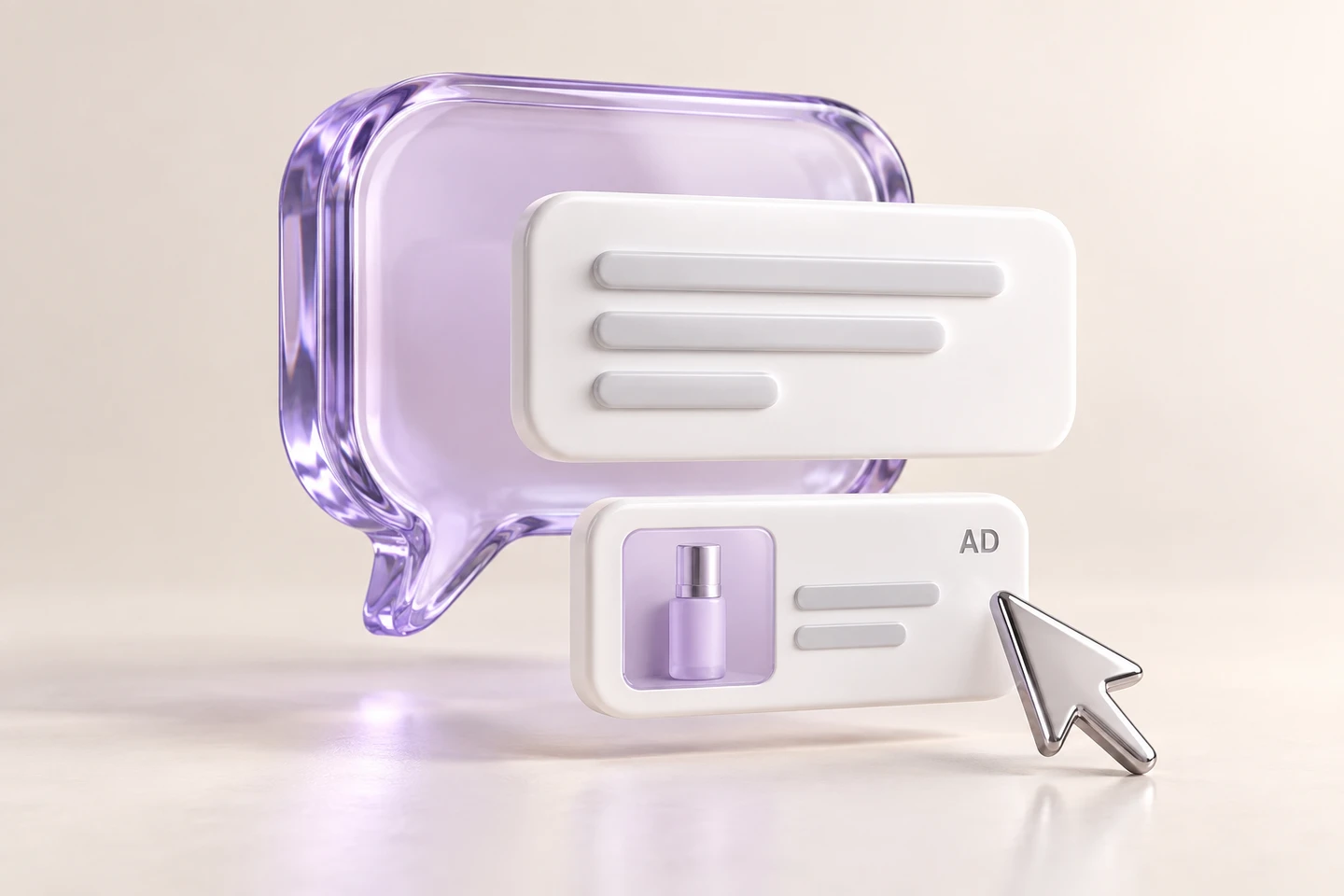
An ad appears below the end of a ChatGPT response. According to OpenAI, it is clearly labelled as sponsored and visually separated from the answer. A standard ad contains the advertiser’s name, a favicon, a headline, a short description, an image and a landing page. A response can be followed by one or more ad units, and a unit can feature several items from one or more advertisers. Retailers can also create campaigns from a product feed.
OpenAI states that ads do not influence ChatGPT’s answers. Ads run on separate systems from the chat model, and advertisers cannot shape, rank or alter a response. By default, ChatGPT cannot see which ads a user is shown. A user can, however, choose “Ask ChatGPT” from the ad’s menu to ask questions about a specific ad.
This design matters for your creative approach. Your ad does not appear inside the recommendation; it appears after an answer that may already mention alternatives, competitors or selection criteria. The ad therefore needs to add something specific: a clear offer, a relevant local service or a landing page that continues the conversation the user was having.
Who sees ads, and where are they excluded?
Ads can appear for users on the Free and Go plans. Plus, Pro, Business, Enterprise and Edu accounts do not see ads. OpenAI does not show ads to accounts it identifies as belonging to people under 18, based on account information and age prediction where available. Temporary Chats do not show ads, and Free users can switch to an ads-free option with lower usage limits.
Placement is also restricted by the conversation itself. OpenAI’s ad policies exclude sensitive user contexts, such as mental and personal health, political content, self-harm and emotionally reliant conversations. They also exclude brand-unsafe topics, including gambling, weapons and misinformation. Someone asking about symptoms, following a political debate or describing a personal crisis should not see an ad next to that conversation.
For advertisers, reach is therefore concentrated in practical and commercial conversations: planning a trip, choosing software, furnishing a home, learning a skill or finding a local service. These are also the examples OpenAI uses when it explains the product to businesses.
How does ChatGPT choose which ad to show?
OpenAI’s ad system considers the context and intent of the current conversation, the ad’s landing page, headline and copy, advertiser-provided context hints and targeting settings. When personalisation is enabled, it can also use select signals from someone’s broader ChatGPT experience, such as past chats, memory and interactions with ads. If several ads are eligible, relevance and bids are combined in a relevance-weighted, second-price auction.
Context hints are set at ad group level. They describe the conversations, topics or keywords in which your product may be relevant, but they are not exact-match keywords and do not guarantee delivery. That is an important difference from a traditional search campaign: you describe situations and intent rather than bidding on a list of exact search terms.
Targeting starts with countries. For most campaigns, you can also target regions, cities, markets and postal codes where available, and choose platforms such as the iOS or Android app, mobile web and desktop web. Custom audiences are available, with at least 25,000 matched users required for inclusion.
There is an important European condition. Personalised ads are not initially available in the European Economic Area or Switzerland, and OpenAI advises against using custom audiences for campaigns in those regions while personalisation is unavailable. For a Dutch campaign, the current conversation, your landing page and your copy therefore carry most of the weight. A precise, well-structured landing page is not a detail; it is part of your targeting.
What does advertising in ChatGPT cost?
There is no fixed price list. ChatGPT Ads uses an auction, and you choose one of three campaign objectives. Views is billed per 1,000 impressions (CPM). Clicks is billed per valid click (CPC). Conversions optimises towards a selected conversion event, but you still pay per click or per 1,000 impressions, not per conversion.
For click campaigns, OpenAI recommends starting with a maximum bid of US$3-5 per click. The minimum daily budget depends on the billing currency; for accounts billed in euros, it is €15 per day. A daily budget is an average over a seven-day period, so spending on a single day can reach up to twice the amount you selected. If you need a hard limit, a campaign-total budget is the stricter control.
The entry threshold has changed considerably. In January 2026, Adweek reported that OpenAI asked select advertisers in the early US beta for a minimum commitment of US$200,000. With self-service Ads Manager, a Dutch business can now start with a small test. Some new self-serve accounts can initially advertise only in their home country; other countries become available after identity verification and a required amount of spend.
OpenAI has not published cost benchmarks by industry. We recommend treating a first campaign as a measured experiment: set a total test budget you are comfortable with, define in advance what a useful result looks like and compare the cost per enquiry or sale with your existing channels.
Which businesses can advertise in the Netherlands?
During the early phase, OpenAI focuses on a limited set of consumer categories: household and consumer goods, local services, travel and entertainment, and digital products and education. OpenAI expects to add categories as its safeguards and review processes mature.
Several categories are currently not allowed, including adult content and dating, alcohol and tobacco, gambling, political and issue ads, recreational drugs and counterfeit goods. Individual job vacancies and property listings are prohibited as well, although a platform with listings may advertise without referring to a specific listing.
The rules are stricter outside the United States. OpenAI states that ads for financial and health services outside the US are generally prohibited, and that ads for legal services outside the US are currently prohibited. In the US, approved advertisers in these categories may be admitted case by case. For a Dutch insurer, clinic or law firm, ChatGPT Ads is therefore not yet a realistic channel. Organic visibility in AI answers remains the more relevant focus.
Every ad must also meet baseline standards: no misleading claims, no offensive language and no imitation of the ChatGPT interface. The whole chain counts, including the landing page. An approved ad may not link to a page that introduces disallowed content.
How to measure ChatGPT Ads results
Ads Manager reports impressions, clicks, spend, click-through rate, average CPC, average CPM and conversions. Advertisers only receive aggregated reporting. According to OpenAI, they do not see users’ chats, memories, names, email addresses, precise locations or IP addresses.
To measure conversions, create a data source in Ads Manager and send events through the OpenAI Pixel, the Conversions API or both. OpenAI adds a click reference, called oppref, to the landing page URL. The Pixel stores it in a first-party cookie so that a later conversion can be connected to the click. If you use both methods, send the same event ID so that a conversion is not counted twice. UTM parameters on your landing page URLs let you follow the traffic in your existing analytics tools as well.
In the Netherlands, measurement is also a privacy question. A tracking pixel and advanced matching with hashed customer data require a valid legal basis and clear information for visitors. OpenAI itself states that conversion data should only be shared where permitted by law. Update your cookie banner and privacy statement before installing a new pixel, and agree who in your organisation owns that decision.
Keep your measurements separate. Impressions show reach, clicks show interest and conversions show an action on your website. The enquiries your team receives, and whether they fit your services, remain the most useful business measure.
ChatGPT Ads, Google Ads and organic AI visibility compared
ChatGPT Ads does not replace your search campaigns or your website content. Each channel answers a different need. The comparison below summarises the main differences for a Dutch business in September 2026.
| Aspect | ChatGPT Ads | Google search ads | Organic AI visibility |
|---|---|---|---|
| Where it appears | Below a ChatGPT answer, labelled as sponsored | Around Google search results, labelled as sponsored | Within an AI answer, as a mention or source link |
| What triggers it | Conversation context, landing page, copy and context hints | Search queries and keyword settings | Useful, accessible content and consistent information |
| How you pay | Per 1,000 impressions or per click | Mostly per click | No media cost; time for content and technical work |
| Control | You choose budget, copy, landing page and targeting | You choose budget, keywords, copy and targeting | Limited: a mention or citation cannot be guaranteed |
| Measurement | Ads Manager, OpenAI Pixel, Conversions API and UTM parameters | Google Ads conversion tracking and analytics | Referrals in analytics, manual checks and enquiries |
| Regulated services in the Netherlands | Financial, health and legal services generally not allowed | Possible within Google’s policies and verification requirements | No ad restrictions; content must be accurate |
Prepare your first campaign: an eight-point checklist
Work through these checks before you create an account at ads.openai.com. For every unchecked item, write down one action and the person responsible. Start with anything that would block approval or make results impossible to measure.
These checkmarks are temporary; your answers are not saved or sent. The checklist helps you prepare and does not guarantee approval or results.
Why organic visibility still matters
An ad appears after the answer. The answer itself is generated independently, and advertising cannot buy a place in it. When ChatGPT explains your category, compares providers or links to sources, your website content and technical accessibility determine whether your business can be part of that explanation.
The two approaches strengthen each other. A landing page that clearly explains your offer, the factors that affect price and your way of working supports a better ad. The same page gives search tools useful information. For ChatGPT search, OpenAI’s crawler OAI-SearchBot needs access to your pages; GPTBot, which is used for model training, is controlled separately. OAI-AdsBot checks the safety of landing pages submitted as ads.
For a business in a restricted category, such as healthcare or financial services, organic visibility is currently the only realistic way to appear in ChatGPT in the Netherlands. Our AI visibility guide explains how to review a page and measure progress.
What comes next for ChatGPT Ads?
OpenAI is developing the platform quickly. On 16 September 2026, it announced a test of Sponsored Agents: after clicking an ad, a user can start a clearly labelled conversation with an agent sponsored by the business. For now, that test is limited to select advertisers in the United States. The same announcement introduced AI tools in Ads Manager for suggested copy and images, an optional feature that adapts ad text to the conversation and translates it, and integrations with HubSpot and Shopify. OpenAI said the Shopify app would become available internationally in ad markets from 23 September.
These developments suggest that advertising in ChatGPT will become more conversational. The fundamentals stay the same: an honest offer, a landing page that answers real questions and measurement you trust. Businesses that organise those fundamentals now can evaluate new formats with less effort once they become available in the Netherlands.
A practical next step
Start with a small, well-defined test. Choose one product or service in an allowed category and write down the conversations in which it would genuinely help someone. Improve the landing page for that situation and set up measurement before you spend money. Review the results after an agreed period and compare them with your search campaigns.
Pixel Studio brings campaign creative, search campaigns, landing pages and SEO/GEO together. Bring your website, your goal and a few recurring customer questions to a conversation. We can help you decide whether ChatGPT Ads suits your business now or whether improving your organic visibility should come first. Media spend and agency work are scoped separately.
Frequently asked questions
Are ChatGPT ads available in the Netherlands?
Yes. OpenAI expanded ChatGPT Ads to 31 European markets, including the Netherlands, in August 2026. Since 31 August 2026, businesses in those markets can buy ads through the self-service Ads Manager, provided their category is allowed.
Can I pay to be recommended in ChatGPT’s answers?
No. According to OpenAI, ads run on separate systems and advertisers cannot shape, rank or alter ChatGPT’s responses. Ads appear below the answer and are labelled as sponsored.
What is the minimum budget for ChatGPT Ads?
For ad accounts billed in euros, the minimum daily budget is €15. OpenAI recommends starting click campaigns with a maximum bid of US$3-5 per click. Actual costs depend on the auction, your category and your targeting.
Do advertisers see what people type in ChatGPT?
No. OpenAI states that advertisers do not receive chats, chat history, memories, names, email addresses, precise locations or IP addresses. Advertisers receive aggregated reporting on their ads.
Who does not see ads in ChatGPT?
Users on the Plus, Pro, Business, Enterprise and Edu plans, accounts identified as belonging to people under 18 and Temporary Chats. Free users can also choose an ads-free option with lower usage limits.
Should a small business start with ChatGPT Ads or with SEO and GEO?
That depends on your category and goals. If your category is allowed and your landing page is ready, a small, measured test can be useful. If your website does not yet explain your offer clearly, improving that foundation first benefits ads, search and AI answers alike.