
Delegate delivery while keeping decisions clear
Outsource Shopify work when specialist skills or reliable delivery capacity would help: product updates, campaign pages, theme changes or technical investigation. Keep commercial priorities, product accuracy and final approval with a named person in your business. Share planning and measurement with your delivery partner.
The right arrangement may be ongoing management, a focused design project or occasional support. Start with a list of recurring tasks and the problems they cause. A new theme will not resolve an unclear approval process, and a monthly retainer is unnecessary for a one-off change.
What can Shopify store management include?
Store management can cover product and collection updates, campaign content, agreed technical checks and coordination of improvements. Define the work in concrete terms: preparing product records, checking variant information, replacing approved banners, reviewing broken links or testing an app-related issue.
A useful task specifies the input, the expected result and the reviewer. “Upload these approved products and check their variants” is easier to deliver than “optimise the catalogue.” Product photography, copywriting, customer support, fulfilment and paid advertising need separate agreement.
A support arrangement should also explain how urgent faults are handled. Routine content work and an interrupted purchase journey have different priorities; define response expectations before a campaign goes live.
When does outside support make sense?
Track which tasks wait, how often they recur and how much internal time they take. Outside support may fit when campaign updates repeatedly miss deadlines, specialist changes exceed your team’s skills or routine work leaves little time for product and customer decisions.
Compare the fee with the full effort involved, including briefing and reviewing work. Training an existing colleague may suit predictable, frequent updates. A project can suit a defined design problem. Ongoing support can suit a changing backlog that needs regular attention.
There is no universal order volume or revenue threshold. Choose an arrangement that matches your workload, budget and ability to provide timely decisions.
What to keep in-house, outsource or share
Use this as a starting responsibility map, then adapt it to your team. Outsourcing execution does not remove the need for someone inside the business to own the outcome.
| Work | Suggested ownership | Practical arrangement |
|---|---|---|
| Pricing, margins and discount limits | In-house | The business sets the rules and approves exceptions. |
| Product facts and customer policies | In-house | The business verifies accuracy and supplies approved information. |
| Product uploads and collection updates | Outsource where useful | A partner applies approved data; the business reviews the result. |
| Campaign pages and merchandising | Shared | The business supplies the offer; the partner prepares and tests the page. |
| Theme development and technical diagnosis | Outsource where skills are needed | Agree the requirement, acceptance checks and release approval. |
| Stock, order and integration exceptions | Shared | Operational owners resolve business questions; technical support investigates system issues. |
| Performance review and priorities | Shared | Review evidence together and choose the next work to fund. |
Management support or a design project?
Outdated campaign content, a catalogue backlog or inconsistent updates may call for a clearer management process. A confusing product page or an unsuitable mobile layout may need design work. Both can be part of the same brief.
For a product-page issue, identify what shoppers need to understand: suitability, ingredients or specifications, use and delivery. Check whether that information is readable and easy to find. Test a focused layout change against those tasks before expanding the project.
Keep the diagnosis separate from the size of the proposed project. A limited improvement may be enough; a wider redesign should have a specific reason.
Theme settings, custom sections, apps or a custom theme?
Shopify’s theme editor supports sections and blocks, but the available options depend on the theme and version. Check those capabilities before specifying new code. A custom-designed store can use an existing theme with tailored components.
A custom theme can support a coherent design system or particular editing requirements. It can still use modular sections and does not automatically improve speed or sales.
Separate appearance from business logic
A bundle builder may need more than a theme section. Shopify documents app and API approaches for bundle configuration and cart behaviour. Define pricing, stock and order handling alongside the interface. Checkout customisation is separate from the theme editor, and advanced options depend on the Shopify plan.
| Option | A possible use | Check before choosing |
|---|---|---|
| Theme settings | Adjust supported colours, typography or page sections | Does the current theme expose the required controls? |
| Custom section or template | Create a distinct product layout or campaign component | Can the team edit it, and how will it be maintained? |
| App or integration | Add specialised functionality or connect another system | Check compatibility, recurring cost and data responsibilities. |
| Custom theme | Deliver a broader set of bespoke templates and components | Compare build, testing and maintenance effort with adapting an existing theme. |
An example plan for the first 30 days
This is a planning example, not a fixed Pixel Shield package or a promise of results within a month. Adjust it to the catalogue, campaign dates and available budget.
Week 1: agree the scope and baseline
Review the current store, backlog and access. Record the starting position before changes: publishing effort, recurring errors and relevant customer-journey measures. Confirm approvals and select the first priorities.
Week 2: resolve the clearest problems
Address agreed issues such as incorrect product information, broken images or a reproducible layout fault. Check the affected journey and document what changed.
Week 3: deliver the next priority
Prepare the agreed product updates, campaign page or theme component. Review it with realistic content and test it before the approved release.
Week 4: review and plan
Compare the work with the baseline, record unresolved issues and set the next priorities. Sales effects may need more observation; account for traffic, campaigns and seasonality before drawing conclusions.
What a useful proposal should specify
Ask how work is estimated, prioritised and approved. Define what “small changes” means and what requires a separate quote. Separate the service fee from Shopify, theme and app charges. Confirm who pays each supplier and whether additional work needs approval.
Keep store ownership with your business and grant only the access needed. Shopify provides collaborator roles for eligible partners, with permissions that you can review and remove. Agree access and documentation handover when the engagement ends.
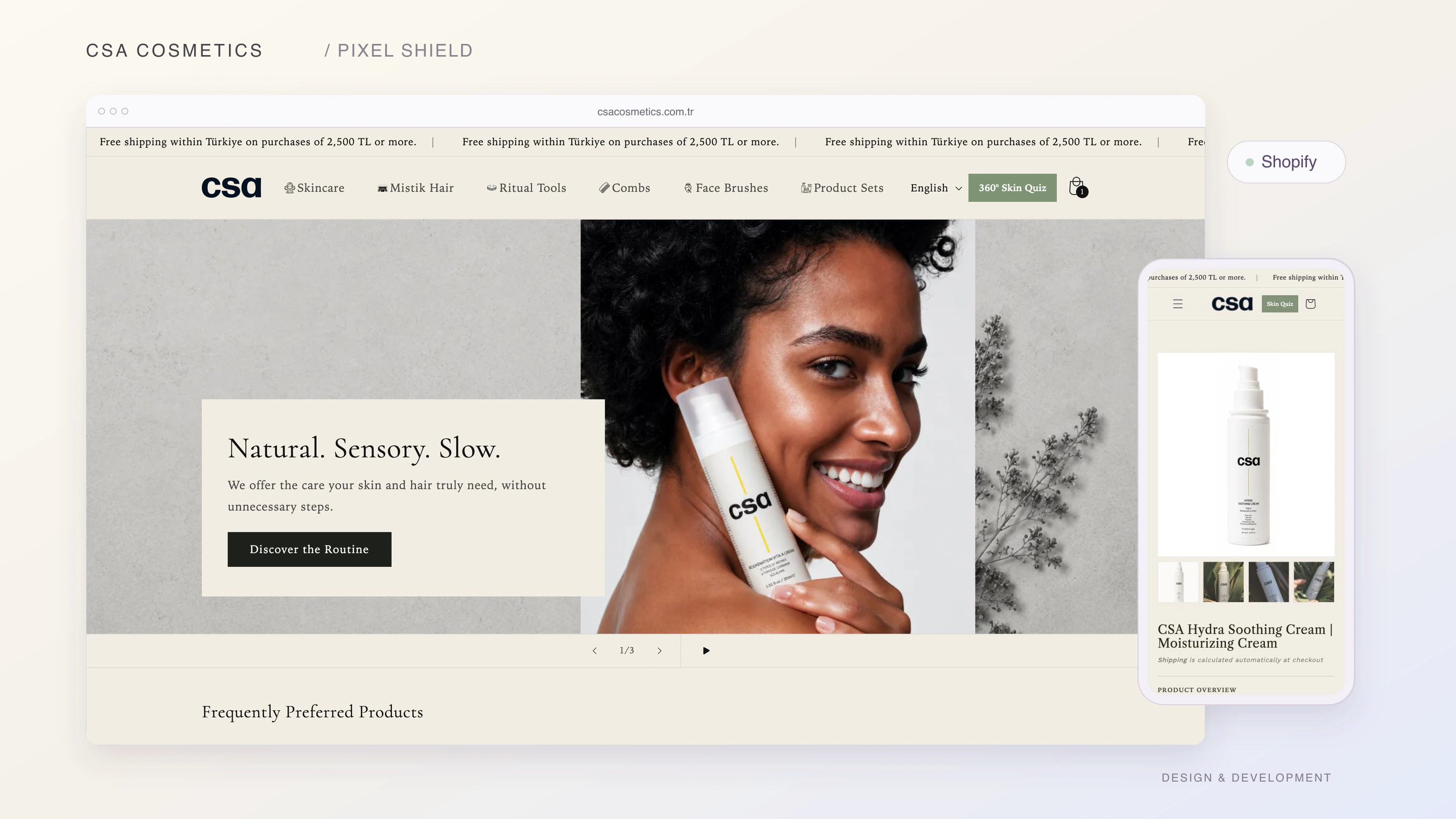
A Shopify website example: CSA Cosmetics
Pixel Shield built the Shopify website for CSA Cosmetics, a cosmetics retailer. You can view the website example in our Shopify service overview and explore the live store. It provides a concrete reference for discussing the presentation your own products need.
Start with the work you need help with
Share your store URL, the tasks taking most of your time and the design changes you are considering. Explore Pixel Shield’s Shopify services or contact the team to discuss a suitable scope.
Frequently asked questions
Can we outsource only part of our Shopify management?
Yes. Scope support around specific work, such as catalogue updates, campaign pages or theme development. Keep responsibilities and approvals clear for the tasks your team retains.
Do we need a custom theme for a distinctive design?
Not always. Assess the existing theme first. Settings, custom sections or templates may provide the required design and editing experience. A full custom theme needs a broader justification.
Does store management include customer service and fulfilment?
Only if the agreement includes them. Product content, technical support, customer service and fulfilment are different responsibilities. Ask for an explicit list of inclusions and exclusions.
How do we assess whether outsourced support is working?
Compare delivery reliability, internal time spent, error levels and agreed customer-journey measures with the starting position. Review commercial results in context; more work completed does not itself prove higher sales.