
The practical starting point
WordPress is often a practical starting point when your website mainly publishes content and your team needs to manage it independently. A more specialised build may make sense when the website is part of a product, depends on complex workflows or needs an unusual user experience.
But “WordPress or custom?” is not a clean either-or choice. You can have a custom-designed WordPress website, a custom application connected to WordPress, or a separate frontend that uses WordPress for content. The useful question is which approach supports your business without creating unnecessary work.
First, separate the design from the platform
WordPress is a content management system (CMS). Custom development describes how something is built. One does not exclude the other: WordPress supports custom themes, plugins and content types, as its official feature overview explains.
For example, a distinctive visual identity does not automatically require a new CMS. A tailored WordPress theme may provide the design freedom you need while retaining familiar publishing tools.
A headless approach is another option: WordPress manages content while a separate application displays it. The WordPress REST API allows other applications to access and manage content. That creates flexibility, but also introduces another system to build and maintain. Choose it for a concrete requirement.
Compare the work behind each option
This table contrasts a conventional WordPress project with a more specialised application. A custom WordPress project can sit between them.
These are planning considerations, not performance or price guarantees. Compare proposals against the same requirements.
| Decision | Conventional WordPress website | Specialised custom application |
|---|---|---|
| Main purpose | Publishing articles, service pages and familiar website features | Supporting specific business rules, workflows or product features |
| Editing | Existing content tools, configured for the team | A selected CMS or editing interface must be included in scope |
| Design | A chosen theme or a bespoke theme | A bespoke interface, with design and development effort budgeted |
| Integrations | Existing connectors where suitable, plus custom development if needed | Integration behaviour designed around the application |
| Initial scope | Established features can reduce setup work | More discovery and implementation may be required |
| Ongoing ownership | Core, theme, plugin and hosting maintenance | Framework, dependency, infrastructure and application maintenance |
When WordPress is a sensible starting point
Consider WordPress when the main job is to explain your services, publish useful content and turn visits into enquiries. It is also worth evaluating when nontechnical colleagues will regularly update pages or publish articles.
Existing themes and plugins can reduce the amount of functionality that needs to be created. Forms, content workflows and common integrations may already have suitable options. However, availability alone does not establish suitability: check licensing, support, accessibility and how the feature works with the rest of the site.
Budget constraints can favour this approach when standard functionality genuinely meets the brief. A heavily customised WordPress project can still require substantial design, development and maintenance. Ask for a demonstration of the actual editing experience rather than assuming every WordPress site is equally easy to manage.
When a more specialised build deserves consideration
Custom development becomes more relevant when the application must follow your processes closely: complex calculations, unusual user permissions, document workflows, live data or interactions that do not map neatly to existing tools.
WordPress can also support custom integrations and application logic. The decision is whether extending it remains clear and maintainable for this particular project. A prototype of the hardest workflow is more useful than a blanket claim that plugins will fail.
For a customer portal or SaaS product, evaluate the data model, permission rules, integrations and expected workload first. Custom development offers control over those choices; it does not automatically make the resulting system scalable. Capacity planning, implementation and testing still matter.
Speed, security and SEO depend on execution
A custom website is not inherently faster than WordPress. Large images, third-party scripts, hosting, caching and implementation decisions can affect either approach. The WordPress optimisation guide covers several of these factors. Agree on representative pages and test conditions before comparing results.
For user experience, Core Web Vitals assess loading, responsiveness and visual stability. Use them to evaluate the delivered site, alongside task completion and accessibility, instead of treating a technology name as proof of quality.
Security also requires ongoing work. WordPress's hardening guidance discusses updates, access controls, backups and trusted software sources. A custom application needs its own maintenance and security plan. Fewer plugins alone do not prove lower risk, and custom code can introduce vulnerabilities.
Neither route guarantees search visibility. Google's SEO Starter Guide emphasises helping search engines access and understand useful content. Include indexable pages, descriptive titles, sensible internal links and a content process in either brief.
Two hypothetical business examples
These invented scenarios illustrate how requirements affect the choice. They are not Pixel Shield client results.
A service business with ten pages and weekly articles
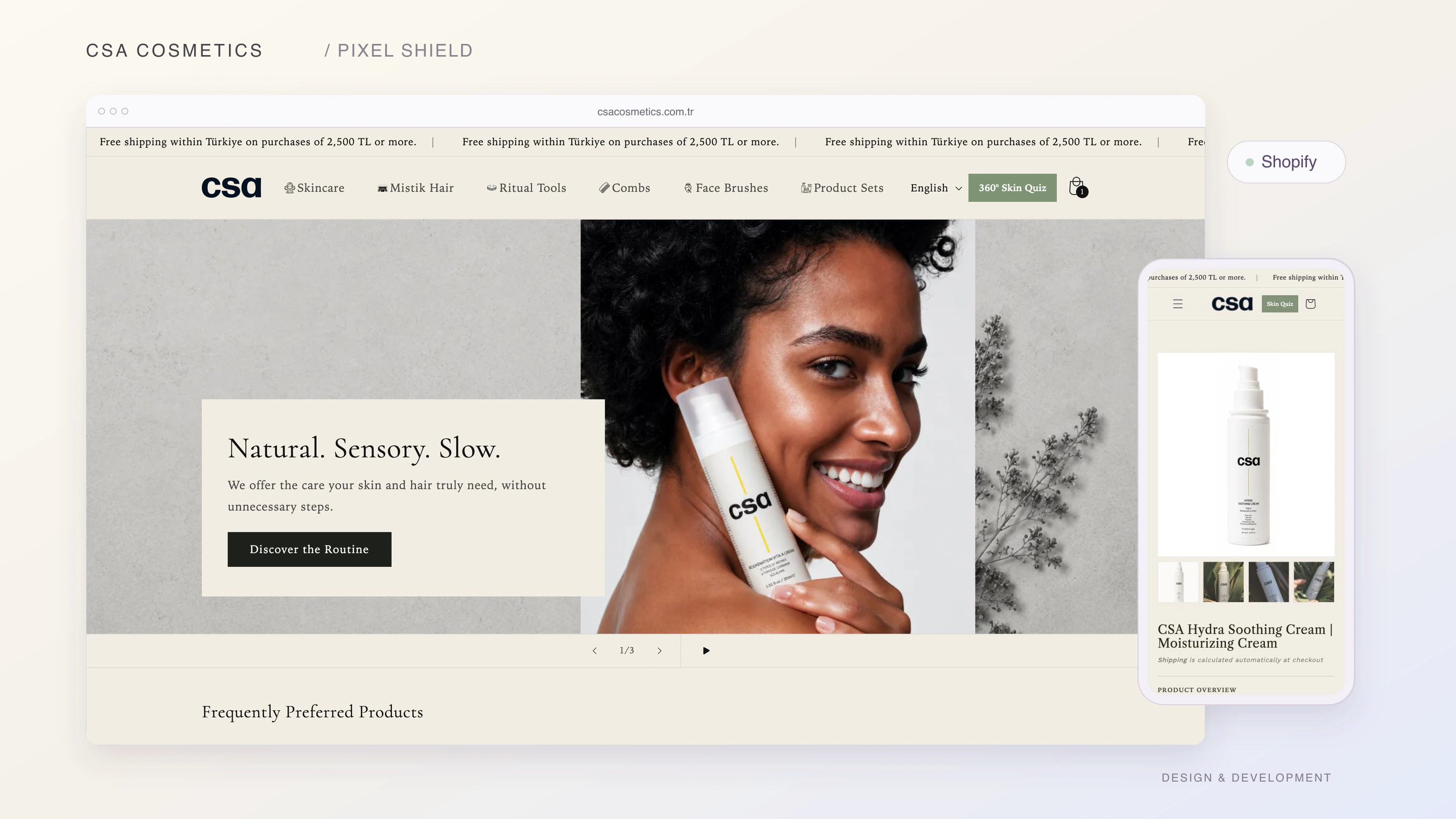
A small Dutch agency needs service pages, a contact form and a blog managed by its team. A carefully scoped WordPress site could be a good fit. Custom design can support its brand without rebuilding the publishing system.
A financial-services customer portal
Imagine a portal with confidential document uploads, market-data feeds and automated billing. A dedicated application may fit its workflows better, potentially with WordPress handling a separate public-facing content site. The choice requires specialist assessment of permissions, data handling, integration reliability and operational responsibilities. Neither architecture guarantees security or compliance by itself.
Compare costs and maintenance over three years
Look beyond the launch quote. Ask both suppliers to include hosting, licences, updates, backups, monitoring, content changes, support and likely integration work. Confirm what happens when an external API changes or a paid component is discontinued.
Separate confirmed needs from possible future features. A three-year direction is useful; building every imagined feature now can make either option unnecessarily expensive.
Use these five questions to compare the proposals.
Choose around the work your business needs to do
Start with your content, customer tasks and operational requirements. Explore Pixel Shield's design services and development services, or contact the team to discuss your current website and the requirements behind your next one.
Frequently asked questions
Can a WordPress website have a unique design?
Yes. WordPress can use a bespoke theme and custom components. A unique appearance does not require replacing the CMS.
Is a custom website always more expensive?
No universal percentage or price difference applies. Scope, integrations, design, editing requirements and ongoing support determine the comparison. Request quotes for the same requirements.
Can we combine WordPress with custom software?
Yes. WordPress can handle publishing while another application handles specialised functions. Define the integration and maintenance responsibilities before committing to that arrangement.